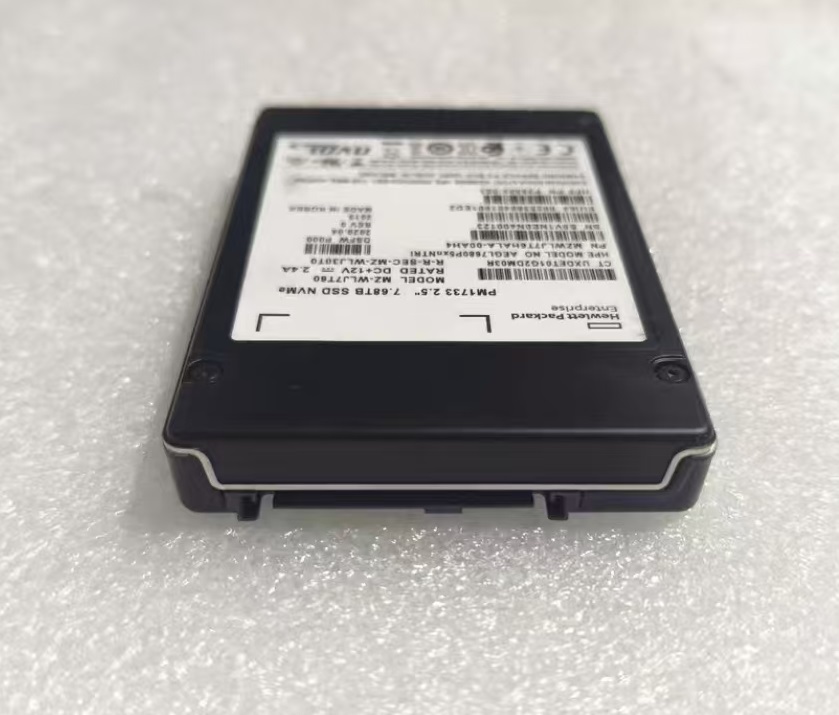
Product Overview
HPE P26502-003 (disk body model PM1733, typically developed in collaboration with Samsung) is a dual port NVMe solid-state drive positioned for top performance, ultimate reliability, and enterprise level critical task workloads. It represents the pinnacle of HPE storage technology, designed to meet the most demanding data intensive applications such as SAP HANA, real-time big data analytics, and high-end virtualization environments. It connects directly to the server through PCIe Gen4 interface, providing unprecedented bandwidth and ultra-low latency.
This hard drive must be used in conjunction with its dedicated NVMe hard drive adapter (such as P37831-002) to properly install it into NVMe supported HPE Gen10 Plus, Gen11 (such as ProLiant Gen11), and newer generation servers and storage systems.
1. Core features and specifications
Capacity: 7.68 Terabytes (TB)
Provides large storage capacity, perfect for in memory databases and large-scale virtualization projects.
Interface and Protocol: NVMe over PCIe 4.0 x4 Lanes
Fully utilize the double bandwidth of PCIe Gen4 to achieve a leap in performance compared to PCIe 3.0 products.
Form Factor: 2.5 inches U.3 (SFF-TA-1001)
U. The 3-interface backplane can intelligently accommodate SAS, SATA, and NVMe hard drives, providing great deployment flexibility. Attention: The server backplane needs to support U.3/NVMe.
Performance indicators (typical values):
Continuous read speed: up to 8000 MB/s or higher
Continuous write speed: up to 3800 MB/s or higher
Random read IOPS (4K): up to 1500000
Random write IOPS (4K): up to 200000
Durability and reliability:
DWPD (Daily Whole Disk Write Count): Usually 1.0-3.0 (within the 5-year warranty period, specific values need to be checked in the official documentation)
TBW (maximum number of bytes that can be written): up to 14 Petabytes (PB) or higher
Mean Time Between Failures (MTBF): 2500000 hours
Advanced features:
Dual Port NVMe: Core Enterprise Features! Provide two independent PCIe ports for active active or active passive high availability configuration, completely eliminating storage single point of failure and meeting the needs of the most critical applications.
Enhanced Power Loss Protection (PLP): Adopting a fully capacitive power-off protection scheme, it ensures that all cached data can be safely written to flash memory in the event of an unexpected power outage, ensuring data integrity.
HPE exclusive firmware and integration: Pre flashing HPE intelligent firmware, providing deep integration with management tools such as HPE iLO and HPE InfoSight, enabling predictive analysis and worry free operation and maintenance.
2. Conversion rack: P37831-002
Function: This is a dedicated NVMe hard drive conversion rack (or shelf) designed for specific HPE server platforms. Its internal circuitry is designed specifically for connecting PCIe signals.
Importance: Never mix with SAS or SATA shelves. The use of the correct bracket is the key to ensuring that the hard drive can be correctly identified and achieve optimal performance and heat dissipation.
Features: Includes hard drive activity/fault status indicator lights, drive positioning indicator lights (used to quickly locate specific hard drives in the chassis), and security lock holes.
3. Typical application scenarios
This top of the line NVMe SSD is designed specifically for enterprise level core applications:
In Memory Databases: such as SAP HANA (preferred application) Oracle Exadata, The ultimate IOPS and low latency are the lifeline.
Mission Critical Apps: Large ERP systems (such as SAP), CRM systems (such as Salesforce).
High performance virtualization and private cloud: greatly improving the performance of platforms such as VMware HANA and Microsoft Hyper-V, supporting ultra-high virtual machine density.
Artificial Intelligence and Machine Learning (AI/ML): Read large training datasets at high speed to accelerate the model training process.
The high-speed data layer of Software Defined Storage (SDS): serving as a caching layer or high-performance storage layer.